The Four DBT Modules Explained: Mindfulness, Distress Tolerance, Emotion Regulation, and Interpersonal Effectiveness
Dialectical Behavior Therapy teaches people to manage intense emotions and build healthier relationships through four core skill modules. According to the National Institute of Mental Health, DBT has demonstrated significant effectiveness in treating conditions like borderline personality disorder, with studies showing reduced self-harm behaviors and improved emotional stability in participants.
At DBT Center of Long Beach, we teach these four foundational modules through individual therapy and group skills training. Each module addresses specific challenges that interfere with daily functioning and emotional well-being. Knowing how these modules work helps you decide if this treatment fits your needs.
What Are the Four DBT Modules?
The Four Pillars of DBT structure includes four distinct skill modules that work together to create lasting change. These modules provide practical tools for managing difficult emotions and relationships.
Each module contains specific techniques you can practice and apply in real-world situations. The skills build on each other to address emotional wellness and interpersonal functioning.
Mindfulness: Building Awareness
Mindfulness teaches you to stay present in the moment without judgment. This module forms the foundation for all other DBT skills because awareness must come before change. You can't modify a behavior or emotion you don't recognize.
Mindfulness skills help you observe your thoughts, feelings and physical sensations without getting caught up in them. You learn to describe experiences objectively rather than reacting automatically. This practice creates space between what happens and how you respond, giving you choice in difficult moments.
Core Mindfulness Skills
The "what" skills include observing, describing and participating fully in the present moment. When you observe, you notice internal and external experiences without words. Describing means putting words to what you notice, using facts rather than judgments. Participating involves throwing yourself completely into activities.
The "how" skills teach you to practice nonjudgmentally, focus on one thing at a time and do what works in each situation. These skills help you let go of rigid thinking patterns that keep you stuck.
Distress Tolerance: Managing Crisis Situations
Distress tolerance skills help you survive difficult moments without making things worse. These tools become valuable during crisis situations when emotions feel overwhelming and you're tempted to act impulsively.
The module includes distraction techniques, self-soothing strategies and methods for accepting reality when you can't immediately change it. You learn to tolerate painful emotions without turning to destructive behaviors like substance use or self-harm. These skills acknowledge that some situations simply hurt and must be endured.
Key Distress Tolerance Techniques
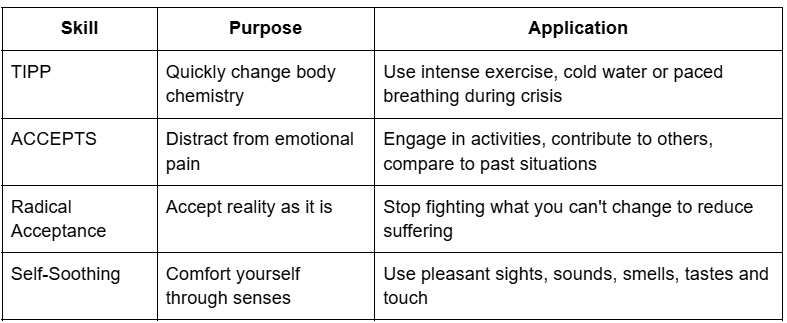
These skills don't solve problems but help you get through intense moments safely until you can address the situation more effectively.
Emotion Regulation: Understanding and Managing Feelings
Emotion regulation teaches you to identify, understand and modify intense emotional responses. This module addresses one of the most challenging aspects of conditions like depression, anxiety and borderline personality disorder.
You learn to name emotions accurately, understand what triggers them and recognize how they affect your thoughts and behaviors. Accurate identification is the first step toward change. Many people struggle to tell the difference between similar emotions like anger and frustration or anxiety and excitement.
Building Emotional Resilience
The ABC PLEASE skills help you build emotional resilience by addressing physical health, sleep and self-care. This acronym stands for accumulating positive experiences, building mastery, coping ahead and treating physical illness, balancing eating, avoiding mood-altering substances, balancing sleep and getting exercise.
This module also teaches opposite action, a technique where you act opposite to your emotional urge when the emotion doesn't fit the facts of a situation. You might approach rather than avoid when anxiety stems from unrealistic fears or get active when depression tells you to isolate.
Our DBT Therapy for Depression in Long Beach & Irvine, CA incorporates emotion regulation skills to help clients improve mood stability and build resilience against depressive episodes.
Interpersonal Effectiveness: Building Healthy Relationships
Interpersonal effectiveness skills help you communicate clearly, maintain self-respect and build satisfying relationships. This module addresses common challenges like difficulty saying no, trouble asking for what you need and conflicts with others.
The DEAR MAN skill provides a structured approach for making requests or saying no while maintaining relationships. You describe the situation, express feelings, assert your needs, reinforce the other person, stay mindful, appear confident and negotiate.
Relationship and Self-Respect Skills
GIVE skills help you keep relationships strong through gentleness, interest, validation and an easy manner. You use these when maintaining the relationship matters more than getting what you want in the moment.
FAST skills focus on maintaining self-respect through fairness, avoiding unnecessary apologies, sticking to values and being truthful. These skills prove valuable for people who struggle with people-pleasing, fear of abandonment or difficulty setting boundaries.
You learn to balance getting what you need with maintaining important relationships. This balance represents the dialectical thinking at the heart of DBT, where you hold two seemingly opposite truths at once.
How the Modules Work Together
The four modules don't function in isolation. Mindfulness supports all other skills by creating awareness of when you need to use them. Distress tolerance helps you survive crisis moments so you can apply other skills once emotions calm down.
Emotion regulation gives you tools to modify difficult feelings before they escalate. Interpersonal effectiveness helps you apply these skills in relationships, where many emotional struggles arise. Each module strengthens and supports the others.
The Modules to master DBT Skills for Emotional Growth in Long Beach & Irvine are typically taught over 24 weeks in group settings, with participants cycling through each module while receiving individual therapy support. This structure lets you learn all skills and then review them for deeper mastery.
FAQs
-
Standard DBT skills training runs for 24 weeks, with each module taught over approximately six weeks. But learning DBT is an ongoing process that continues beyond initial training as you practice applying skills in daily life.
-
Group skills training is considered a necessary component of comprehensive DBT. The group setting provides opportunities to practice interpersonal effectiveness skills, receive feedback and learn from others' experiences. Individual therapy alone typically doesn't provide the same level of skill acquisition.
-
All four modules work together as an integrated system. Mindfulness serves as the foundation, but each module addresses different aspects of emotional and interpersonal functioning. The most helpful module varies depending on your specific challenges and treatment goals.
-
DBT was originally developed for borderline personality disorder but now treats various conditions including depression, anxiety, PTSD, eating disorders and substance use. Our Free DBT vs RO-DBT Assessment can help determine if standard DBT or Radically Open DBT better fits your needs.
Getting Started With DBT Skills Training
Learning the four DBT modules provides practical tools for managing emotions and improving relationships. These evidence-based skills have helped thousands of people build lives worth living.
If you're ready to develop these skills,contact us for a free assessment to learn more about our comprehensive DBT programs in Long Beach and Irvine.